UN BUEN PROFESIONAL . PRECISA DE UNA BUENA DOCUMENTACION TECNICA.

Para la compra de cuaquier libro de este blogg puede mandar un correo electronico a info@ingenieriayarte.com o a traves de nuestra pagina web. www.ingenieriayarte.com indicandonos nombre, direccion, poblacion y telefono de contacto .Dentro de España los envios son realizados por mensajeria 24 horas a cargo de MRW. Canarias y Ceuta los envios son por Correos España mediante Paquete Azu

Para cualquier envio Internacional los envios son por Agencia de transporte a su domicilio.Puede efectuar su pedido a traves de www.ingenieriayarte.com de forma comoda calcula los gastos de envio


lunes, 11 de febrero de 2013

SISTEMAS FLEXIBLES DE ALTA RESISTENCIA EN LA ESTABILIZACION DE TALUDES

Sistemas flexibles de alta resistencia en la estabilización de taludes
SISTEMAS FLEXIBLES DE ALTA RESISTENCIA EN LA ESTABILIZACION DE TALUDES
Revision de los metodos de diseño existentes y propuesta de una nueva
metodogia de dimensionamiento
Elena Blanco Fernandez

Los sistemas flexibles de alta resistencia anclados al terreno son una de las distintas técnicas existentes para la estabilización de taludes, ya sean de roca o de suelo. Están constituidos por una membrana (red de cables o malla de alambre) sujeta al terreno mediante placas de anclaje, cables de refuerzo y bulones. Se estima que alrededor de 1.000.000 de m2 son instalados cada año en todo el mundo. Actualmente no existen guías técnicas de carácter oficial que definan de forma rigurosa el comportamiento de estos sistemas, su procedimiento de cálculo y su modo de instalación. Son generalmente los mismos fabricantes los que desarrollan sus propias guías internas de diseño e instalación. La motivación de este trabajo radica precisamente en esta carencia de normativa técnica objetiva con un adecuado rigor científico. El presente trabajo recoge de forma íntegra la tesis doctoral defendida por la autora el 6 de mayo de 2011 en la Universidad de Cantabria. Su director de tesis, Daniel Castro Fresno, es Profesor Titular en la E.T.S.I. Caminos, Canales y Puertos de la Universidad de Cantabria. Posee 42 artículos científicos indexados, 12 patentes y más de 60 contribuciones a congresos

Observaciones 2013
Medidas 17x24
Paginas 312
Precio  95,00 Euros


miércoles, 6 de febrero de 2013

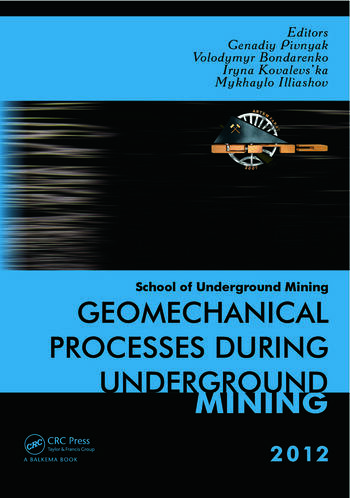
GEOMECHANICAL PROCESSES DURING UNDERGROUND MINING

 
GEOMECHANICAL PROCESSES DURING UNDERGROUND MINING
Volodymyr Bondarenko, Iryna Kovalevska,Mykhaylo Iliiashov,Genadiy Pivnyak

This volume deals with economic aspects of mining companies’ development strategies, various mineral deposits development techniques, imitational modeling of mine workings with rock massif, methane extraction technologies during coal mining, geomechanical processes during plow mining, mining transport importance for mineral extraction, massif strain-stress state management using non-explosive destructing materials, and surface mining's detrimental influence on the environment.
Special attention is paid to alternative ways of mining, such as borehole underground coal gasification for extraction of hardly accessible coal and development of gasification plant and development and use of alternative sources of energy such as gas hydrates and sun energy are also disucssed in this book.
This collection of scientific papers will be of interest to mining engineers, engineering technicians, designers, scientific and research personnel, students, postgraduates, and all mining-related professionals working in the coal and ore industry.
 
Coal industry developments in the Ukraine
Over-coal thin layered massif deformation of weak rocks
Finite-element method for multi-parameter system "Rock Massif - Combined Support" computation
Mine working destruction
The thickness variation seams
Finite-element modelling
Spontaneous combustion and coal dust explosibility
Methane and artificial gas extracting
Brown coal underground gasification
Degassing systems
Geomechanical processes at plow longwall mining in weak rocks
Reliability and carrying capability of support service vehicles
Monitoring by method of conductivity
Analysis of stress-strain state of rock mass
Rock displacement
Influence of coal seams gasification on bearing rocks
Hydrodynamic cavitation in energy-saving technologies in mining industry
Economic aspects of development strategy of mining companies
Methods of determining untidust respirator quality
Unexplosive destroying materials

Observaciones 2012
Medidas 17x24
Paginas 300
Precio  135,00 Euros

ADVANCES IN UNSATURATED SOILS


ADVANCES IN UNSATURATED SOILS

Berardo Caicedo,Carol Murillo,Laureano Hoyos,Julio Esteban Colmenares

New theories and testing techniques related with Unsaturated Soil Mechanics have proven to be valuable tools to study a broad spectrum of geo-materials which includes rocks, rock fills, frozen soils and domiciliary solid wastes. These new theories and testing techniques have permitted the analysis of several traditional problems from a new perspective (e.g., swelling or collapsible soils and compacted soils or pavements materials), and they have also shown their efficiency to study new energy-related problems like CO2 sequestration and nuclear waste disposal.
Advances in Unsaturated Soils is a collection of papers from the 1st Pan-American Conference on Unsaturated Soils organized in Cartagena de Indias, Colombia, in February 2013. The volume includes 76 research papers coming for all over the world, as well as 7 keynotes papers by well known international researchers. The contributions present a variety of topics including:
• Advances in testing techniques
• Unsaturated soil behavior
• Constitutive modeling and microstructure
• Numerical modeling
• Geotechnical problemsAdvances in Unsaturated Soils
is expected to become a useful reference to academics and professionals involved in Unsaturated Soil Mechanics.

Preface

Organization committees
Acknowledgements
Sponsors
Keynotes lectures

Interactions between atmosphere and geosphere—difficulties in measuring evaporation
G.E. Blight
Interpretation of soil-water characteristic curves when volume change occurs as soil suction is changed
D.G. Fredlund & S.L. Houston
Ventilation effects in an argillaceous rock tunnel examined via unsaturated soil mechanics
A. Gens & B. Garitte
Compacted soils: From physics to hydraulic and mechanical behaviour
S. Leroueil & D.W. Hight
Rockfill mechanics
L.A. Oldecop & E.E. Alonso
Unsaturated soil mechanics in the design and performance of pavements
H. Sahin, F. Gu, Y. Tong, R. Luo & R.L. Lytton
Estimation of the 1-D heave of a natural expansive soil deposit with a light structure using the modulus of elasticity based method
S.K. Vanapalli & H.H. Adem
Advances in testing techniques
Physical modelling of the effect of partial saturation on the stability of geocell walls
D. Gómez
Calibration in the laboratory of capacitance sensors for water content monitoring
F. Avanzi, M. Caruso & C. Jommi
Unsaturated soil response under plane strain conditions via true triaxial testing
L.R. Hoyos, J.A. Cruz & A. Lizcano
Measuring water retention properties of a series of bentonite clays in a wide range of suctions
D. Marcial
Physical modeling of the mechanical improvement of unsaturated silt through heating
C.J.R. Coccia, A. Casady & J.S. McCartney
Triaxial cell for nonisothermal shear strength of compacted silt under high suction magnitudes
N.A. Alsherif & J.S. McCartney
Measurement of friction on piles over neutral plane in expansive soils
C. Mendoza
On the use of unsaturated properties of a sandy material for centrifuge model preparation
W.F. Morales, J. Laue & S.M. Springman
Application of electrical resistivity for the control of water content and density in loess
V. Rinaldi
A method for making a homogeneous specimen of unsaturated clay using micro-wave
H. Suzuki, Y. Okano, K. Ueno & R. Uzuoka
Centrifuge modelling of wetting-induced collapse in embankment base
L. Thorel, I.M. Khokhar, V. Ferber & B. Caicedo
A practical method for suction estimation in unsaturated soil testing
M.F. Amaral, A.V. da Fonseca, E. Romero & M. Arroyo
Preparing unsaturated samples of decomposed granite for laboratory controlled CPTs
H. Yang & A.R. Russell
Estimating soil hydraulic parameters from capillary rise tests
T.C. Zapata & O.M. Vilar
Geophysical investigation of cracking in unsaturated soils
G. Jones, M. Zielinski & P. Sentenac
Unsaturated soil behavior
Water retention behavior and hydraulic properties
Preferential flow and mass transport modeling in a heterogeneous unsaturated soil
L.B. Bien, R. Angulo-Jaramillo, D. Predelus, L. Lassabatere & T. Winiarski
Influence of cracks on soil water characteristic curve
S. Azam, M. Ito & F. Khan
Influence of suction on the permeability of unsaturated soils
B. Melbouci & F. Ghanem
Evaluation of the suction calibration curves for Whatman 42 filter paper
K.V. Bicalho, K.F. Cupertino & A.I. Bertolde
Soil water characteristic curves of lime-treated highly expansive soils
T.Y. Elkady & A.M. Al-Mahbashi
Water retention properties of a demolition waste
A.M.J. Gómez, M.M. Farias, M.P. Cordão-Neto, M.V.R. Souza & I.F. Otálvaro
Water infiltration in final cover layer of landfills in northeast region of Brazil
R.L. Lopes, J.F.T. Jucá & M.O.H. Mariano
Water retention properties of a residual soil from Caracas
A. Luis & D. Marcial
Air permeability of cover soil from the Bandeirantes landfill in São Paulo, Brazil
F.A.M. Marinho & P.F. Teixeira
Water retention curves for a tropical soil contaminated by vinasse
M.G. Miguel & S.Y. Pereira
Permeability studies with blend of fly Ash and Rice Husk Ash stabilized soil subgrade
N.L. Patil, S. Sharma & H. Sood
Capillary rise in pores with rough walls
L.E. Vallejo
Volumetric and elastic behavior
Multi-dimensional swelling behavior of Al-Qatif expansive soils
M.F. Abbas, T.Y. Elkady & M.A. Al-Shamrani
Soil characterization and compressibility parameters of Bogotá clay due to suction changes
G.E. Ávila, A. Ledesma & A. Lloret
Cyclic behavior of unsaturated unbound aggregates for pavements
B. Caicedo, O. Coronado, J.M. Fleureau & A. Gomes-Correia
Small strain shear modulus of an unsaturated sandy soil
G.B. Georgetti & O.M. Vilar
Swelling behavior of expansive clays incorporating mineralogy and pore size distribution via SWCC
A. Pedarla, A.J. Puppala & L.R. Hoyos
Drying-wetting tests on sand—silt mixtures: Impact of volumetric changes on the retention curves
M. Morvan, D. Branque, H. Wong & B. Colin
Collapse behaviour of a natural loess from Northern France
J.A. Muñoz-Castelblanco, P. Delage, J.M. Pereira & Y.J. Cui
Elastic response of unsaturated soils
C. Murillo, B. Caicedo, L. Thorel & C. Dano
Evaluation of soil matric suction, microstructure and its influence on collapsible behavior
J. Ramos & Y. Valencia
An experimental study on the stiffness of a lime-treated clayey soil
A.M. Tang, M.N. Vu & Y.J. Cui
Effects of relative humidity cycling on the hydro-mechanical behaviour of two clayey rocks from North-East Spain
J.A. Pineda & E. Romero
Laboratory experiments on swelling due to crystal growth in sulphate argillaceous rocks
A. Deu, E.E. Romero & I.R. Berdugo
Shear and tension behavior
Solute suction and shear strength in saturated soils
V.Y. Katte & G.E. Blight
Effect of pre-shearing/suction histories on residual shear strength of unsaturated soils
L.R. Hoyos, C.L. Velosa & A.J. Puppala
Review of factors affecting formation of cracks in clay layers
C. Lozada
Evaluating the impact of thermal variations on the penetration test parameters
G. Franchomme, S. Rosin-Paumier & F. Masrouri
Using fracture mechanics theory to evaluate the unconfined compressive strength of unsaturated fissured clays
L.E. Vallejo
Fractal evaluation of the fragmentation of clays due to desiccation
L.E. Vallejo
Critical combination of tensile and shear stresses causing the crack propagation path in brittle clays subjected to uniaxial compression
L.F. Vesga & L.E. Vallejo
Crack propagation and threshold strength of fissured clays subjected to cyclic loading
L.F. Vesga & L.E. Vallejo
Constitutive modelling and microstructure
Hydro-mechanical formulation considering fluid compressibility
S.R.C. Brant-P-de-Jesus, M.P. Cordão-Neto & I. Fernandes-Gomes
Volumetric behavior of unsaturated-reconstituted soils
G.J. Burton, D. Sheng & E. Romero
Micromechanical study of the compressibility of unsaturated granular materials
R. Barata & R. Cardoso
Progressive emergence of double porosity in a silt during compaction
F. Casini, J. Vaunat, E. Romero & A. Desideri
State surface of wetting-drying cycles at the equilibrium stage
E. Jahangir, F. Masrouri & H. Nowamooz
Assessment of the critical state strength of unsaturated aggregated soils
E.J. Murray, R.M. Jones & V. Sivakumar
Incorporating a microstructural state variable in constitutive modeling
N.M. Pinyol, E.E. Alonso & A. Gens
Effect of loading and suction history on time dependent deformation of coarse crushed slate
E. Romero, C. Alvarado & E.E. Alonso
DEM modeling of unsaturated rockfill. Scale effects
M. Tapias, E.E. Alonso & J.A. Gili
Incorporation of the soil-water characteristic curve hysteresis in pavement design
D.C. Rosenbalm & C.E. Zapata
Results of unsaturated tests on metastable soils
J.C. Ruge, R.P. da Cunha & D. Mašín
Numerical analysis of unsaturated soil behaviour under large deformations
B.C.F.L. Lopes & M.P. Cordão-Neto
Numerical modelling
Study of the influence of climatic effects on the soil temperature and suction changes
K.V. Bicalho, G.P.W. Vivacqua & Y.J. Cui
Numerical analysis of effect of rainfall infiltration on unsaturated soil
E.F. Garcia, C.A. Riveros & J.C. Saldarriaga
The impact of moisture diffusion on the structural degradation of asphalt mixtures
S. Caro
Shafts by the Sequential Excavation Method: Mechanical vs Hydro-mechanical calculations
C.C. Dias, A.T. Gomes & J. Vaunat
A lattice model for liquid transport in unsaturated porous materials
C. Fahy, P. Grassl & D. Gallipoli
Numerical simulation of a shallow foundation on an unsaturated silt
N.A. González & A. Gens
Cyclic macroelement for shallow footing over unsaturated soil
B. Kafle & F. Wuttke
BEST method: Characterization of soil unsaturated hydraulic properties
L. Lassabatere, R. Angulo-Jaramillo, T. Winiarski & D. Yilmaz
Unsaturated flow of unfrozen water in frozen soils
A. Shastri, M. Sanchez & A. Lizcano
Probabilistic analyses of slope stability under infiltration conditions
I.F. Otálvaro & M.P. Cordão-Neto
Modeling gas hydrate bearing sediments using a coupled approach
M. Sanchez, A. Shastri & J.C. Santamarina
Effect of soil replacement option on surface deflections for expansive clay profiles
A. Bharadwaj, S.L. Houston, W.N. Houston, B. Welfert & K.D. Walsh
Geotechnical problems and soil atmosphere interaction
Capillary barrier dissipation by new wicking geotextile
M. Azevedo & J.G. Zornberg
Suction stress influence on strength parameters used in geotechnical engineering
R. Baltodano-Goulding
Quantification and modeling of water flow in sandy soils in Northeast Thailand
S. Seltacho, V. Sriboonlue, N. Suwanang, W. Wiriyakitnateekul & C. Hammecker
A rainfall threshold for the occurrence of landslides in manmade slopes in residual soils in the northwest of Colombia
C.H. Hidalgo & A.P. de Assis
Use of artificial intelligence in Soil compaction modeling
E.L.P. González
Author index

Observaciones 2013
Medidas 17x24
Paginas 610
Precio  220,00 Euros

viernes, 25 de enero de 2013

CONSTRUCCION DE ESTRUCTURAS DE MADERA

CONSTRUCCION DE ESTRUCTURAS DE MADERA | 9788492579842 | Portada

CONSTRUCCION DE ESTRUCTURA DE MADERA
Eduardo Medina Sanchez

Este libro se dirige a estudiantes y profesionales del mundo de la construcción interesados en las estructuras de madera.

Se incluyen numerosos detalles constructivos, tablas y fotografías, de estructuras tradicionales y modernas, con un fin práctico y actual para la ejecución de rehabilitaciones y de obra nueva.

Se describen los diferentes elementos y sistemas estructurales, cómo trabajan y cómo se unen entre sí, respetando las características de la madera para lograr la máxima durabilidad, y todo ello de acuerdo al Código Técnico de la Edificación y su Documento Básico “Seguridad Estructural. Madera”.

INDICE EXTRACTADO:

Capítulo 1. La madera como material estructural.

Capítulo 2. Materiales y productos derivados. Clases resistentes.

Capítulo 3. Durabilidad de la madera. Sistemas de protección.

Capítulo 4. Uniones entre piezas de madera.

Capítulo 5. Concepción estructural. Nociones de cálculo.

Capítulo 6. Entramados verticales.

Capítulo 7. Entramados horizontales.

Capítulo 8. Entramados inclinados.

Capítulo 9. Estructuras trianguladas.

Capítulo 10. Estructuras de madera laminada.

Capítulo 11. Entramados ligeros de madera.

Observacion 2013
Paginas 300
Medidas 17x24
Precio  24,95 Euros

CAESBA.PROGRAMA DE CALCULO DE ESTRUCTURAS

CAESBA. Programa de Cálculo de Estructuras |  | Portada

CAESBA
PROGRAMA DE CALCULO DE ESTRUCTURAS
José Miguel Martínez Jiménez; José Miguel Martínez del Valle; Alvaro Martínez del Valle

CARACTERISTICAS Y FUNCIONES DEL PROGRAMA:

El programa CAESBA es un programa ejecutable desarrollado en Visual Basic que permite:

a)Calcular todaslas tipologías de estructuras de barras y de vigas.

b)Hacer cálculos con cargas estáticas y determinar las cargas depandeo para estructuras planas de nudos rígidos.

c)Dispone de un interfaz gráfico fácil y potente que permite generarsinesfuerzo las características geométricas, mecánicas y distribución de cargas exteriores de estructuras de geometría y/o estados de carga complicados.

d)Tiene una alta vocación pedagógica y es muy interactivo, permitiendo el acceso a las fases intermedias del cálculo: matrices de rigidez etc.

e)Los resultados se refieren tanto a corrimientos como a esfuerzos en suselementos.Proporciona diagramas de esfuerzos, así como valores de los esfuerzos o corrimientos enpuntos interiores de las vigas.

f)Dispone de una ayuda para su aprendizaje y manejo muy completa, que describe pormenorizadamente todas las habilidades y forma de proceder.

g)Dispone de la posibilidad de exportar los datos de la estructura a unfichero Word para poder calcular, alternativamente, la estructura exportada con otros programas. La sesión inicial del trabajo comienza con la ejecución del ejecutable CAESBA y una lectura detenida delmanual de ayuda que lleva incorporado elpropio programa.

Observaciones 2013      EDICION SOPORTE CD.ROM
Medidas 17x24
Paginas   CD.ROM
Precio  190,00 Euros


MANUAL DEL INGENIERO DE EDIFICACION
GUIA PARA EL CALCULO DE ESTRUCTURAS CON CYPECAD
Carlos Pardo Soucase, Esther Valiente Ochoa

Este manual pretende ser una guia visual completa con todos los pasos a seguir para el correcto calculo de estructuras de edificacion a traves de CYPECAD.
La seleccion del programa no solo se realiza por la efectividad y potencia de su sofware sino tambien por el alcance profesionañ que tiene el todo el colectivo profesional
La metodologia de presentación recoge muchos años de experiencia docente,cuya retroalimentacion ha servido de base para plasmar en el las fortalezas de todos los usuarios,intentando resolver los puntos criticos que los tecnicos competentes pueden encontrar en su ejercicio profesional
La singularidad de la propuesta se basa en la resolucion de casos concretos y la utilizacion de imagenes comentadas que,paso a paso,nos permiten guiarnos en el manejo de este programa y capatirarnos para el calculo de estructuras de edificacion

INDICE

1- Datos previos
Introduccion
Conceptos generales
2- Modelizacion
El programa
Datos generales
La seccion
La estructura
La cimentacion
3 - Calculo,analisis y resultados
Calculo y analisis
Resultados
Anexos

Observaciones 2013
Paginas 184
Medidas 21x25
Precio 47,30 Euros

martes, 15 de enero de 2013

BRIDGE DESIGN & EVALUATION LRFD AND LRFD


Bridge Design and Evaluation: LRFD and LRFR (0470422254) cover image
 
BRIDGE DESIGN & EVALUATION LRFD & LRFR
Gongkang Fu
 
A succinct, real-world approach to complete bridge system design and evaluation
Load and Resistance Factor Design (LRFD) and Load and Resistance Factor Rating (LRFR) are design and evaluation methods that have replaced or offered alternatives to other traditional methods as the new standards for designing and load-rating U.S. highway bridges. Bridge Design and Evaluation covers complete bridge systems (substructure and superstructure) in one succinct, manageable package. It presents real-world bridge examples demonstrating both their design and evaluation using LRFD and LRFR. Designed for a 3- to 4-credit undergraduate or graduate-level course, it presents the fundamentals of the topic without expanding needlessly into advanced or specialized topics.Important features include:

  • Exclusive focus on LRFD and LRFR
  • Hundreds of photographs and figures of real bridges to connect the theoretical with the practical
  • Design and evaluation examples from real bridges including actual bridge plans and drawings and design methodologies
  • Numerous exercise problems
  • Specific design for a 3- to 4-credit course at the undergraduate or graduate level
  • The only bridge engineering textbook to cover the important topics of bridge evaluation and rating
Bridge Design and Evaluation is the most up-to-date and inclusive introduction available for students in civil engineering specializing in structural and transportation engineering.  

Preface xi
1 Introduction
1.1 Bridge Engineering and Highway Bridge Network
1.2 Types of Highway Bridges
1.3 Bridge Construction and Its Relation to Design
1.4 AASHTO Specifications and Design and Evaluation Methods
1.5 Goals for Bridge Design and Evaluation
1.6 PreliminaryDesign versus Detailed Design
1.7 Organization of This Book
References

2 Requirements for Bridge Design and Evaluation

2.1 General Requirements
2.2 Limit States
2.3 Constructability
2.4 Safety
2.5 Serviceability
2.6 Inspectability
2.7 Economy
2.8 Aesthetics
2.9 Summary
References
Problems

3 Loads, Load Effects, and Load Combinations

3.1 Introduction
3.2 Permanent Loads
3.3 Transient Loads
3.4 Load Combinations
References
Problems
4 Superstructure Design
4.1 Introduction
4.2 Highway Bridge Superstructure Systems
4.3 Primary Components of Highway Bridge Superstructure
4.4 Deck Systems
4.5 Deck-Supporting Systems
4.6 Design of Reinforced Concrete Deck Slabs
4.7 Design of Steel I Beams
4.8 Design of Prestressed Concrete I Beams
References
Problems

5 Bearing Design

5.1 Introduction
5.2 Types of Bridge Bearing
5.3 Appropriate Selection of Bearings
5.4 Design of Elastomeric Bearings
References
Problems
6 Substructure Design
6.1 Introduction
6.2 Piers
6.3 Abutments
6.4 Foundations
6.5 Design of Piers
6.6 Design of Abutments
References

7 Highway Bridge Evaluation
7.1 Introduction
7.2 Inspection and Condition Rating
7.3 Load Rating
7.4 Fatigue Evaluation for Steel Components
References
Problems
Index
Problems

Observaciones 2013
Paginas  456
Medidas 17x24
Euros  125,00